Understanding Trenchless Pipe Lining: Solving Fall Root Intrusions Before Winter
Home /
The Hidden Threat Beneath Your Lawn: Fall Root Growth and Slow Drains
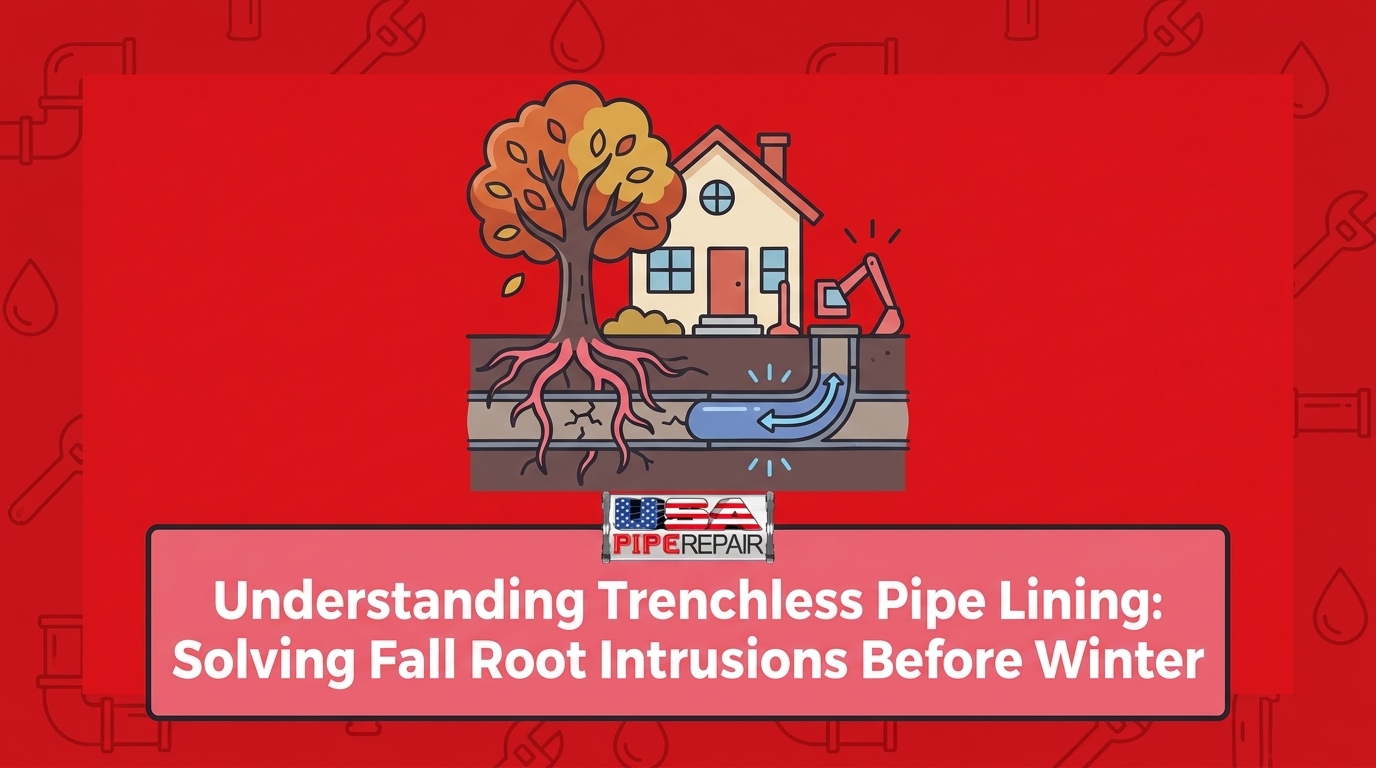
If you are searching for local service expertise and area tips regarding sluggish autumn drains, the first thing our team at USA Pipe Repair wants you to understand is that these sudden backups are rarely a coincidence. You run the sink, and the water hesitates before spiraling down. The shower begins to pool around your ankles during a morning routine. Perhaps you even hear a faint gurgling sound coming from the toilet when the washing machine drains. We consistently tell our customers that these are not isolated quirks of an aging plumbing system; they are the early warning signs of a severe underground conflict happening right beneath your lawn. As we move into the October pre-winter season, tree roots are actively seeking out the moisture inside your sewer lines, creating a critical decision point for homeowners: address the vulnerability proactively now, or risk a catastrophic, freeze-induced blockage when the ground hardens.
In our experience working on Midlothian properties, we’ve found that before a minor backup turns into a winter emergency, investing in professional pipe lining services or comprehensive trenchless sewer repair can save your property from extensive damage. The traditional approach to fixing a broken sewer line involved bringing in heavy machinery, tearing up your yard, and replacing the pipe entirely. Today, modern no-dig restoration offers a minimally invasive alternative that fortifies your plumbing from the inside out.
A pattern we see often includes these common signs that roots have breached your system:
- Persistent slow drains: Multiple fixtures draining slowly at the same time usually indicates a main line blockage rather than a localized clog.
- Unusual gurgling noises: Air trapped by root masses creates a bubbling sound as water struggles to pass through the restricted pipe.
- Foul odors in the yard: Sewage seeping into the surrounding soil through root-created cracks often produces a distinct, unpleasant smell.
- Unexplained lush patches of grass: If one section of your lawn is suddenly greener and growing faster than the rest, it is likely feeding on a subterranean leak.
For homes in Midlothian VA, recognizing these symptoms early is the key to preserving both your plumbing infrastructure and your landscaping before the freezing temperatures arrive.
Why Tree Roots Aggressively Target Sewer Lines in Autumn
To understand why your plumbing is under attack, you have to look at the biological imperatives of the trees on your property. As the days grow shorter and temperatures begin to drop, trees sense the approaching winter dormancy. To survive the colder months, their root systems go into overdrive, aggressively expanding outward and downward in a desperate search for moisture, oxygen, and essential nutrients. Unfortunately for your plumbing, a residential sewer line is an absolute goldmine of all three.
This biological drive is compounded by local environmental factors. Here in Virginia, our crews frequently see how humid summers followed by heavy downpours cause the soil to undergo intense periods of expansion and contraction. This constant shifting puts immense hydrostatic pressure on underground infrastructure. Older clay, cast-iron, or Orangeburg pipes naturally develop hairline cracks under this stress. When a tree’s microscopic root hairs encounter these tiny fissures, they force their way inside. Once inside the pipe, the roots find a constant supply of warm, nutrient-rich water, causing them to multiply rapidly.
As the root mass grows, it acts like a biological net. Toilet paper, grease, soap scum, and other debris catch on the intricate root fibers. What starts as a minor restriction quickly snowballs into a dense, impenetrable blockage. By the time the October pre-winter chill sets in, a pipe that was only slightly compromised in August can become completely choked off, setting the stage for a severe backup into your home.
The Anatomy of a Pipe Breach
The process of root intrusion is entirely invisible from the surface, but it follows a predictable, scientifically understood pattern. It begins with vapor escape. Even a microscopic crack in a sewer line releases warm water vapor into the surrounding soil. Tree roots are naturally hydrotropic, meaning they grow in the direction of moisture gradients. They detect this vapor trail and grow directly toward the source.
Once the root tip penetrates the crack, the environment inside the pipe triggers explosive growth. The roots no longer have to push through dense, compacted soil; instead, they are suspended in an open channel with continuous fertilization. The roots expand in diameter, acting like a slow-motion wedge that widens the initial crack, compromising the structural integrity of the pipe and inviting even more roots to enter the system. This rapid expansion is precisely why autumn drain issues escalate so quickly.
The Science of Cured-In-Place Pipe (CIPP) Technology
When our technicians are faced with an invasive root system and a cracked sewer line, we know the solution is not just to cut the roots away—they will simply grow back. The solution is to eliminate the entry points entirely. This is where the science of Cured-In-Place Pipe (CIPP) technology comes in. CIPP is a trenchless restoration method that essentially creates a brand-new, structurally sound pipe directly inside your existing, damaged one.
The process relies on advanced materials engineering. A flexible felt or fiberglass liner is saturated with a specialized, two-part epoxy resin. This liner is then inserted into the damaged sewer line and inflated so that it presses tightly against the interior walls of the old pipe. As the epoxy cures, it hardens into a rigid, seamless barrier. Because the new pipe is completely jointless, there are no seams, cracks, or connections for tree roots to exploit in the future.
The material strength of this epoxy resin is remarkable. Once fully cured, the CIPP liner meets or exceeds the structural standards of brand-new PVC piping. For the homeowners we serve in Midlothian VA, this seamless nature is particularly crucial. The jointless barrier is highly resistant to the seasonal ground freezing and thawing cycles typical in the region. When the soil shifts and traditional pipe joints flex and break, the continuous CIPP liner maintains its integrity, ensuring that your wastewater flows smoothly regardless of the environmental pressures above.
Step-by-Step: The Professional No-Dig Restoration Process
Trenchless pipe lining is a highly technical procedure that requires specialized professional equipment and extensive training. It is not a weekend project, and it requires precise diagnostics to ensure the liner bonds correctly to the host pipe. Understanding the steps our licensed crews take helps demystify the process and highlights why we recommend it for resolving October pre-winter plumbing crises.
- High-Definition Camera Inspection: The process always begins with a diagnostic assessment. A specialized, waterproof camera is fed into the sewer line through an existing cleanout. This allows the technician to map the exact location of the root intrusions, identify any structural collapses, and measure the precise dimensions of the pipe.
- Hydro Jetting and Mechanical Descaling: Before a liner can be installed, the host pipe must be completely cleared. Technicians use high-pressure hydro jetting and mechanical descaling tools to obliterate the invading tree roots, scour away years of calcified scale, and flush out accumulated grease. This restores the pipe to its original diameter and provides a clean surface for the epoxy to adhere to.
- Resin Saturation and Liner Insertion: The custom-measured felt liner is laid out and saturated (or “wet out”) with the liquid epoxy resin. Using specialized inversion equipment, the liner is blown or pulled into the freshly cleaned sewer line. The inversion process turns the liner inside out as it travels, ensuring the resin side presses firmly against the walls of the old pipe.
- The Curing Process: Once the liner is in place, a calibration tube is inflated to hold it tight against the host pipe. Depending on the specific resin formulation and environmental conditions, the curing process is accelerated using ambient air, hot water, or steam. Within a few hours, the liquid resin transforms into a rock-solid structural pipe.
- Final Video Inspection: The calibration tube is removed, and the camera is sent down the line one last time to verify that the new pipe is perfectly smooth, fully cured, and completely free of defects.
It is important to note that you do not always need to line the entire length of your sewer system. If our camera inspection reveals that the root intrusion is isolated to a single joint or a small section of the pipe, our professionals can utilize a sectional point repair. This targeted fix uses the exact same CIPP technology but is scaled down to patch only the compromised area, saving time and resources while still providing a permanent seal.

The Critical Timeline: Why Proactive Maintenance Prevents Winter Emergencies
When dealing with compromised plumbing, time is rarely on your side, but the transition from autumn to winter introduces a hard deadline. Dropping ground temperatures dictate the timeline for proactive plumbing work. During the October pre-winter window, the ground is still relatively soft, making it easy to access cleanouts and perform necessary hydro jetting. Once the frost line deepens, the dynamics of underground plumbing change drastically.
A pattern we see often during late fall service calls is water freezing inside a root-compromised pipe. If tree roots have slowed the flow of wastewater to a trickle, water sits in the pipe longer than it should. When the surrounding soil temperature drops below freezing, that stagnant water turns to ice. Because water expands as it freezes, the resulting pressure can easily shatter an older clay or cast-iron pipe that is already weakened by root intrusion. What was once a slow drain is now a completely collapsed sewer line.
Dealing with a catastrophic pipe failure in the middle of winter is a logistical nightmare. Emergency excavation during the winter months is significantly more complex, disruptive, and time-consuming. Heavy machinery struggles to break through the frozen earth, and the displaced soil often freezes in large chunks, making it impossible to backfill the trench properly until spring. Furthermore, if our team finds a pipe that is severely degraded and cannot structurally support a CIPP liner, we may need to use alternative trenchless methods like pipe bursting to replace the line entirely. Diagnosing and executing these solutions is infinitely smoother before the ground freezes solid.
Preserving Your Property: The Landscaping Advantage
Beyond the structural benefits to your plumbing, the most immediate advantage of trenchless technology is the preservation of your property. Traditional sewer repair is inherently destructive. To access a broken pipe the old-fashioned way, a crew must dig a trench that follows the entire length of the sewer line, from your foundation all the way to the municipal connection at the street.
This process destroys everything in its path. Driveways are jackhammered, custom patios are dismantled, retaining walls are compromised, and mature trees—often the very trees that caused the root intrusion in the first place—must be uprooted or severely damaged. For homeowners in Midlothian VA who have invested heavily in their curb appeal, the collateral damage of a traditional sewer repair can be devastating.
| Feature | Traditional Excavation | Trenchless Pipe Lining |
|---|---|---|
| Property Disruption | Extensive. Destroys lawns, hardscaping, and driveways. | Minimal. Uses existing cleanouts or small access pits. |
| Project Timeline | Often takes several days to a week or more. | Typically completed within a single day. |
| Post-Repair Restoration | Requires extensive landscaping and concrete replacement. | Virtually none. The yard remains intact. |
| Root Resistance | New pipe joints remain vulnerable to future root entry. | Seamless epoxy liner eliminates all root entry points. |
Trenchless methods operate entirely differently. By utilizing existing cleanouts or creating a single, small access point, technicians can restore the entire length of the pipe underground. At USA Pipe Repair, our team’s specialized expertise in minimally invasive, no-dig technology ensures that your pipe integrity is completely restored without destroying established landscaping. You get the peace of mind of a brand-new sewer line without the headache of hiring a landscaping crew to put your yard back together.
Comparing No-Dig Solutions: When is Lining the Right Choice?
While CIPP lining is a phenomenal technology, it is not the only trenchless tool available, and it is not the correct solution for every single problem. Understanding the difference between lining and bursting helps clarify why professional diagnostics are so critical during the October pre-winter season.
The Problem: You have a damaged sewer line, but the extent of the damage dictates the cure. CIPP lining requires a “host pipe” to hold the shape of the liner while the epoxy cures. If your pipe has minor cracks, small holes, or moderate root intrusion, our technicians will typically recommend lining as the ideal choice. The host pipe is still structurally sound enough to act as a mold for the new epoxy barrier.
The Cause for Alternative Action: However, if the root intrusion has gone unchecked for years, the pressure may have caused the pipe to completely collapse. Alternatively, the pipe may have developed a severe “belly” (a sag in the line where water pools) or the joints may be drastically offset. In these scenarios, a flexible liner would simply take the shape of the collapsed or sagging pipe, failing to resolve the flow issues.
The Solution: When a pipe has lost its structural integrity, professionals turn to pipe bursting. This method involves pulling a conical bursting head through the old pipe, shattering it outward into the surrounding soil, while simultaneously dragging a brand-new, high-density polyethylene (HDPE) pipe into place behind it. In our day-to-day operations, we rely on a thorough camera inspection as the only way to determine the correct scientific approach for your unique situation. If you are curious about the mechanics of this alternative, you can explore the science behind trenchless sewer replacement. Both methods share the ultimate goal: providing a permanent, root-proof solution while avoiding mass excavation.
Frequently Asked Questions About Trenchless Pipe Lining
Can trenchless pipe lining fix tree roots?
Yes, trenchless pipe lining is one of the most effective ways to permanently fix tree root intrusions. Before the liner is installed, technicians use high-pressure hydro jetting to completely clear the roots from the line. Once the epoxy liner cures, it creates a seamless, jointless barrier that prevents roots from ever re-entering the pipe.
Why do tree roots enter sewer lines in the fall?
Tree roots enter sewer lines in the fall because trees are aggressively seeking moisture and nutrients before they go dormant for the winter. As the soil dries out and temperatures drop, roots naturally gravitate toward the warm water vapor escaping from microscopic cracks in aging sewer pipes.
What happens if sewer pipes freeze?
If a sewer pipe freezes, the water trapped inside expands and exerts massive pressure on the pipe walls. For older pipes in Midlothian VA that are already weakened by root intrusion, this expansion can cause the pipe to shatter or collapse entirely, leading to catastrophic backups and requiring emergency winter excavation.
How long does trenchless sewer repair last?
Trenchless sewer repair provides a highly durable, long-term solution for aging plumbing. The epoxy resins used in Cured-In-Place Pipe (CIPP) lining are engineered to withstand extreme pressures, chemical corrosion, and root intrusion, often lasting for decades without requiring further maintenance.
Can trenchless lining be performed in colder weather?
While trenchless lining can be performed in colder weather, it is significantly more complex and requires specialized curing methods like steam or hot water to ensure the epoxy hardens correctly. We highly recommend completing these repairs in the autumn before the ground freezes solid to avoid emergency complications.
Secure Your Plumbing System Before the Frost Arrives
Understanding how fall weather, soil shifting, and aggressive root growth impact your underground pipes is the first step in protecting your home. Sluggish drains in the autumn are a clear signal that your system is under stress, and ignoring these warning signs only increases the likelihood of a severe freeze-burst when temperatures plummet.
Our team highly recommends a professional camera inspection during the October pre-winter window as your most effective defense against seasonal plumbing emergencies. By accurately diagnosing root intrusions now, you have the opportunity to utilize minimally invasive trenchless technology to fortify your pipes. Don’t wait for a complete blockage to force your hand. Take proactive steps to secure your plumbing system today, ensuring that your property remains safe, functional, and undisturbed throughout the cold months ahead.
Schedule Service
Our Services
More About Us



Get in Touch With the Top-Rated Plumber in Richmond, VA Today!
See for yourself why we're the top choice for top-notch, budget-friendly general plumbing, drain cleaning, excavation, and sewer repair services. Complete client satisfaction is what we aim for every time. Contact us today by calling us or filling out the form to schedule an appointment or request assistance.
In Business Since: 2001
State Licensing
Trade: Plumbing
License #: 2705140622
Expiration: 11-20-2022
Trade: Landscape Service Contracting
License #: 2705140622
Expiration: 11-20-2022
Trade: Highway / Heavy Contractors
License #: 2705140622
Expiration: 11-20-2022
Trade: Master Plumber
License #: 2710066245
Expiration: 02-28-2022
Trade: Class A Contractor
License #: 2705140622
Expiration: 11-20-2022